---
title: "How To Write Your Signature Talk"
author: "Taylor Conroy"
url: "https://library.leadr.co/2/write-your-signature-talk"
---


Introduction 

# Introduction

<div style="display: flex; align-items: center;">
<div style="flex: 1;">
<p>
Hi there! 
<br> 
<br>
Taylor Conroy here, and I'm thrilled you're taking the first step towards sharing your message with the world.
<br>
<br>
Because if you're feeling that pull to speak, then trust me - you're in good company!</p>

At LEADR, we've helped 750+ people, just like you, land signature talks that have moved mountains.

<br>
<br>

And we've seen it happen in as little as 3 months.

</div>

<div style="flex: 1;">
<img src="https://library.leadr.co/u/screenshot-2025-04-25-at-11-07-34-am-C1RS0u.png" alt="Screenshot" width="400"/>
</div>

</div>
<br>

Maybe you're a coach with a life-changing framework.

Or a newly retired entrepreneur eager to share the wisdom you've gained.

Or maybe you're simply someone with a burning passion and a desire to make a difference.

No matter your background...

If you've got a message inside your heart and mind, you've got what it takes to deliver a killer signature talk.

Now, I know what you might be thinking:

#### <div align="center"> "A signature talk? That sounds intimidating! </div>
#### <div align="center"> I'm not a professional speaker."  </div>

That's exactly why I created this book.

Inside, you'll discover a simple, step-by-step system for crafting a compelling signature talk…

Even if you've never spoken publicly before.

- It's about tapping into your unique story…

- Connecting with your audience on an emotional level…

- And delivering a message that resonates long after the lights go down.

By the end of this mini-book, you will: 

- Gain crystal-clear clarity on the core message you want to share

- Develop a foolproof talk outline that flows naturally and keeps your audience engaged

- Write a powerful and authentic signature talk that captures your voice and passion

- Feel confident and ready to take the next step towards landing your stage

So, grab a pen and paper (or your favorite note-taking app), and let's get started.

It's time to get your message out of your heart... 

Out of your mind... 

And into the world where it belongs!

# Overview of the 7 Sections

Alright, so you've got:

✔️ The passion

✔️ The message

✔️ And the desire to share it with the world

Now it's time to put it all together.

And I'm going to show you exactly how to do that.

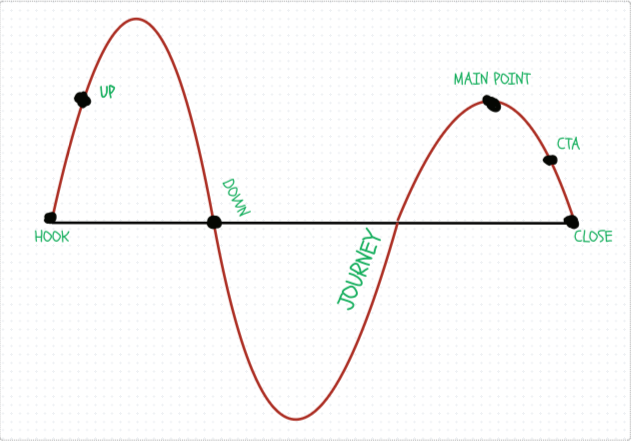
Think of your signature talk as a journey—a carefully crafted emotional experience that takes your audience on a ride. 

And like any good journey, it has a clear structure and a distinct purpose.

We're going to break down your signature talk into 7 key sections. 

These are carefully selected building blocks that create a lasting connection with your audience.

And trust me, it goes in this specific order for a reason.

Here's a sneak peek at the path we'll be following:

<div align="center">

<img src="https://library.leadr.co/u/screenshot-2025-03-24-at-3-32-56-pm-LyVMI8.png" alt="Screenshot" width="600"/>

</div>

Let's get started!

### The Hook: Grab Their Attention (Fast!)

Imagine this: 

The lights dim, you walk on stage, and all eyes are on you. 

How do you instantly captivate your audience and make them ANTICIPATE what you have to say? 

This section is about crafting an irresistible opening that grabs their attention and refuses to let go.

### The Up Story: Make Them Forget It's a Talk 

People aren't there to be lectured. 

A compelling talk will show people that you are also a PERSON! 

It's about crafting an emotional connection and building trust through relatable storytelling. 

The number one point of the up story? 

Make them forget you are even giving a talk!

### The Down Story: Create Emotional Contrast

You can't have highs without lows.

This is where you dive into your own experiences, and pull on those heart strings. 

Why is this important? 

Because people follow those they empathize with! 

If you want to connect with your audience…

They need to connect with the real you.

### The Journey: Show Them How You Got There

You can't just show people the destination; they also need to know how you got there.

This section will help you lay out all the stepping stones on your journey so people can see how you learned and experienced all that you have.

### The Main Point: Deliver Your Key Message

You have to have a point for all this, right? 

Now that we have the audience, their attention, and their trust…

It’s time to deliver! 

This is the section where you can incorporate all the data you’ve gathered for your talk.

### Audience Impact: Make It About Them

Next, take your hard-earned knowledge…

And hand it over to the audience.

Essentially, your knowledge will become a tool for the audience to use themselves for themselves. 

### The Close: Leave Them Empowered

You went through the trouble to get to an emotional high. 

Don't blow all of this hard work by sending people out feeling amped up with nowhere to put all that new emotion. 

Bring people home with a powerful takeaway they can easily apply.

In the following chapters, we'll break down each of these sections one by one.

You'll learn practical strategies and complete actionable exercises to bring your signature talk to life.

Ready to dive in? Let's go!

Intention of Your Talk

# Intention of Your Talk

Before we dive into the nitty-gritty details of crafting your signature talk, there's something even more important we need to get crystal clear on: 

### YOUR INTENTION

- Why are you really doing this talk?

- What's the fire burning inside you that's driving you to step onto that stage?

- What's the world you see when you put your message out there?When you decide to give a talk…

You’re making the decision to connect with your audience on a soul level so you can inspire them to take action.

Your intention is your North Star.

It's the guiding light that will keep you on track when you're feeling lost, overwhelmed, or just plain stuck.

It's the compass that will ensure your talk stays true to your heart and delivers a message that resonates with authenticity and power.

So, how do we tap into this intention?

I'm going to guide you through a little exercise to help you connect with the deepest "why" behind your talk.

Disclaimer: It might sound a little woo-woo, but trust me, it works!

### Exercise: Connect With Your Why

Grab a pen and paper.

Find a quiet space where you can relax and focus without distractions.

Close your eyes (if you feel comfortable doing so), and take a few deep breaths.

### 1. Feel Your Heart

Bring your attention to your heart center (aka the area in your chest where your heart resides)

Feel the energy in that space. 

Feel the life pumping through you.

### 2. Imagine Your Talk, Multiplied

Now, imagine your signature talk is out there, reaching millions of people around the globe. 

Picture people listening intently, feeling inspired, and taking action because of what you shared.

### 3. How Do You Want Them to Feel? 

In that moment, how do you want those people to feel? 

What emotions do you want to evoke? 

Write down the first words that come to mind.

No judgment, just let it flow. (e.g., inspired, empowered, hopeful, connected, courageous, seen)

### 4. How Do You Want the World to Be Different? 

Now, imagine the ripple effect of your talk spreading throughout the world. 

How would the world be different if everyone watched your talk and fully absorbed your message? 

What positive changes would you see? Write down the images, ideas, and words that come to mind. (e.g., More compassion, greater understanding, a stronger sense of community, more action on climate change, less hate, more love)

### 5. Distill It Down

Look at the words and images you've written down. 

What's the essence of your intention? 

What's the one word, phrase, or sentence that encapsulates the deepest "why" behind your talk? 

#### Write it down – this is your North Star.

Here's an example: 

My intention is to ignite the spark of compassion and inspire a world where everyone feels seen, valued, and loved.

Take your time with this exercise.

#### There's no right or wrong answer.

The goal is simply to connect with the authentic power that's already within you.

This connection will be invaluable as we move forward in crafting your signature talk.

What's that thing that you want that audience (and the world) to come away with most?

Chapter 1: The Hook


# Chapter 1: The Hook

### Grab Their Attention (Fast!)

Okay, so picture this:

You're on stage.

The spotlight hits you.

The audience is a sea of faces, all staring right at you.

#### What's the first thing you say?

That first sentence, those first 30 seconds – it's everything.

It's gonna have people reach for their phones to scroll...

Or lean in to listen.

It's your opportunity to make a statement.

And it's why this whole chapter matters.

Think of the hook as the movie trailer.

It’s the first glimpse of your film that lets the people know it's the movie they should be watching.

So, how do you instantly captivate your audience and make them crave more?

This section is all about that.

Your number one goal right here, is simple:

### Get people to keep watching.

There's two main ways people go about setting up the first moment of the talk.

And the world's biggest signature talks have used them for decades:

### Strategy 1: Ask a Question That Blows Their Minds

You may have noticed — people naturally feel spoken to when you ask a question.

It makes them feel seen, involved, and curious about what’s coming next.

But here's the kicker:

It has to be a damn good question.

The worst thing you can do is ask a boring question or ask something that isn't relevant.

Some of the biggest talks use an "is this true or not" question:

"What if I told you that confidence isn’t something you’re born with — it’s something you practice?"

"What if I told you that losing all your money actually helps build your business?"

"What if I told you that rest, not hustle, is the real secret to productivity?”

The goal of questions like these is simple:

#### Get people thinking, “Wait… what?” 

Then keep them leaning in for the answer.

### Strategy 2: Start Mid-Story 

There's a few reasons people love to start in the middle of a story - one of them is because that's what people do every day.

I'm not just talking from a signature talk point of view, but as a life point of view:

When you are going to talk to your friends or family about your day, where do you think that you start?

You can be sure you are NOT taking them through your coffee purchase or morning emails.

You tell them about a fight you had…

Something amazing that happened…

Or that you finally have a solution to a problem!

#### And that's where you will hook people.

Here are some ways to think about mid-story:

- "There I was.... stuck in the Andes, and down hundreds of feet from the nearest safety."

- "I never wanted to be a speaker, you know - I was afraid. But then one day..."

- "It was over, I was done. I closed my company and laid in bed for days."

 ![eBook #1 Doodles-3.png](https://library.leadr.co/u/ebook-1-doodles-3-KcfYLh.png) 

### Hook Brainstorming Exercise

Let's brainstorm:

1. Grab a sheet of paper, and set a timer for 2 minutes.Use the strategies above and write down as many potential hooks as you can - go for quantity over quality right now.

2. If the questions are something that you can get people asking themselves in their head, then it's good.

3. Think of this hook as the headline that everyone is going to read.

Congratulations! This is how your story begins.

Chapter 2: The Up Story


# Chapter 2: The Up Story

Make Them Forget It's a Talk

So, you've reeled them in with your hook. 

Now here comes the part that everyone forgets (even speaking coaches):

You need to make sure people see you as human.

Look, a signature talk can NOT be seen as a lecture.

People's brains and hearts don't like lectures.

They like being involved.

And they LOVE stories.

In your Up Story (which is not necessarily happiness and sunshine) you are going to share the REAL you.

This section is all about crafting an emotional connection and building trust through relatable storytelling.

Here’s why:

## Storytelling is The Key to a Connection

Let’s start with what not to do:

Don’t walk on stage and immediately rattle off who you are, how successful you’ve been, or everything the audience can learn from you.

That’s the fastest way to lose them.

Instead, invite them in.

Help them see that you’re just like them — real, relatable, and a little imperfect.

That’s the goal of your Up Story.

(Not necessarily sunshine and rainbows — but something real, lighthearted, and personal.)

This story isn’t about proving your worth.

It’s about building trust.

It’s a chance to share a slice of your life that makes people smile, lean in, and think:

“Okay… I like this person.”

The #1 goal of this section?

Make your audience forget they’re watching a talk.

Make them feel like they’re listening to a friend.

Stuck? Try These Prompts:

If you’re wondering what to share, here are a few places to start:What’s a funny or unexpected story from your childhood?

What happened on your first date?

What’s the best (or weirdest) vacation you’ve ever taken?

When was the last time you laughed so hard you cried?Still stuck? Ask yourself:

“What’s a moment that always gets a good reaction when I tell it to friends?”

The point isn’t to be perfect.

The point is to be you — in the most real, natural, and memorable way.

Because when you show up as your true self, people either love you or… don’t.

But they will remember you. And they will trust you.

![up story.png](https://library.leadr.co/u/up-story-pqOeFV.png) 

### Up Story Brainstorm Exercise

Let’s get your story flowing.Grab a sheet of paper.

Set a timer for 2 minutes.

Use the prompts above to brainstorm as many “Up Story” ideas as you can.

Choose your top three — the ones that feel the most like you.Congratulations.

You’ve just cracked open the hearts of your audience — and they’re ready to go on this journey with you.

Chapter 3: The Down Story


# Chapter 3: The Down Story

### Create Emotional Contrast

Now we’re getting into the part that makes your talk real. 

This is the Down Story — the moment your audience sees your struggle, your vulnerability, and your humanity.

If your talk was only about the happy stuff, trust me — no one would care. 

People don’t just want inspiration. 

They want to feel something real. 

They want to know that you’ve been where they are.

This section is about emotional contrast — the low that gives your high its meaning. 

Important Note: It’s not about making people sad. 

It’s about helping them connect by showing that growth often comes from pain.

### Choosing the Right “Down”

Your down story doesn’t have to be rock bottom. 

But it should be personal. 

And it should relate to your message.

Remember — in the Up Story, you made people smile. 

You made them see that you’re human. 

Now you let them see a part of you that’s honest. 

A moment that shaped you. 

That broke something open. 

That made the journey necessary.

Ask yourself: 

- Did you walk away from something that was supposed to be your dream?

- Did everything fall apart — business, relationships, identity?

- Was there a moment you felt completely lost… and no one knew?

This is the moment that helps people feel with you.

Not because they pity you.

But because they’ve been there, too.

And now, they trust you even more.

### Get to the Heart of It

Here are a few prompts to dig into your story:What words/emotions do you associate with that time? (e.g., lost, stuck, ashamed, angry, numb)

What was the moment you realized things had hit a low point?

How did your world feel in that single moment - emotionally, physically, mentally?Be honest with yourself. 

This part of your talk might be hard to tell — but it’s also what makes it powerful.

Your audience doesn’t want perfect. 

They want real.

![down story.png](https://library.leadr.co/u/down-story-IFY2uq.png) 

### Down Story Brainstorm Exercise

Set a timer for 2 minutes.

Choose one emotion — something that still stirs something in you.

Write about a moment that brought that emotion to the surface.

Visualize where you were, what was happening, and how it felt.Don’t overthink it. 

Just get it out.

Congratulations. 

You’ve just opened the door for your audience to walk beside you.

Now, they’re not just listening — they’re with you.

Chapter 4: The Journey

# Chapter 4: The Journey

### Show Them How You Got There

You’ve made them laugh. 

You’ve made them feel. 

Now it’s time to show them the steps that brought you from that emotional low to the big realization.

This is the very reason you’re giving this talk!

This part of your talk is the emotional climb. 

It’s the phase of the story where you piece together the experiences, stories, and lessons that led you to your insight. 

It’s not one dramatic moment that makes the shift — it’s usually several. 

This section shows how you learned, tried, failed, and grew.

Think of it like the rising action in a great movie. 

The setbacks, the smaller wins, the surprises. 

 ![eBook #1 Doodles-3.png](https://library.leadr.co/u/ebook-1-doodles-3-MvA5gb.png) 

All of it adds context and emotional momentum to your main idea.

This is where your audience truly starts to believe you. 

They’ve seen your high, they’ve felt your low, and now they’re walking alongside you. 

That builds trust. 

And that trust sets the stage for your big idea to land.

 ![your journey.png](https://library.leadr.co/u/your-journey-aRupl3.png) 

### Journey Brainstorm Exercise

Jot down all the key turning points that moved you from your down moment toward your insight.

What were the experiments, realizations, or conversations that changed how you thought?

Put those moments in order. What came first? 

What did you try next? 

What worked? 

What didn’t?

Ask yourself: 

Which of these stories are the most powerful or fun to tell? 

Which ones best guide the audience to the aha moment?

Pro Tip: Once you have the timeline, practice telling this section aloud. 

Not every moment needs to be included — just the ones that pull the audience forward and make your point stronger.

Congratulations. 

You’ve built the bridge from pain to possibility.

Chapter 5: The Main Point

# Chapter 5: The Main Point
 
### Deliver Your Key Message

This is it — the heart of your talk. 

The core idea. 

The big takeaway.

Everything up to now has led here. 

The audience is emotionally invested. 

They’re curious. 

And they trust you. 

That makes this the perfect moment to deliver your idea.

So what’s the message you most want people to walk away with?

It could be a belief, a framework, a method, or a shift in mindset.

But it should be clear, specific, and actionable. 

Important Note: This is not the time for vague or abstract. 

People should be able to repeat it back and feel like they “got it.”

### A Few Prompts to Get Clear

- If your audience only remembers one thing from your talk, what should it be?

- What’s the most important truth you’ve discovered from your journey?

- What’s your talk really trying to prove?

This is also where you can bring in data, research, or other supporting evidence. 

Use anything that makes your idea more credible and more memorable — a quote, a stat, a metaphor, or a visual.

For example, in a talk I delivered on-stage about generosity, my main point was: 

#### “When you combine the five motivators of giving, not only will people give - they’ll thank you for the opportunity to do it.”

That’s the kind of clarity you’re aiming for.

 ![main point.png](https://library.leadr.co/u/main-point-qtsZS6.png) 

### Main Point Brainstorm Exercise

Write down your main point in one simple sentence.

List out the supporting evidence or examples that will help drive it home.

Practice saying it out loud — and see if it feels like something people could repeat or carry with them.

Nail this, and you’ve got the beating heart of a great talk.

Chapter 6: Audience Impact


# Chapter 6: Audience Impact

### Make It About Them

Now that you’ve delivered your insight, the question becomes: 

What does this mean for your audience?

This is the "so what?" moment.

It’s where your talk becomes more than a story or a lesson. 

It becomes a tool for transformation.

You’ve shown them how you got the insight. 

Now show them how they can apply it.

What can someone in your audience actually do with what you’ve shared?

This is where you can:

Offer a practical takeaway

Suggest a small but powerful action

Share a story of someone else who applied your idea and got resultsIf you want them to take the next step with you — like staying connected or learning more — this is the section where you can lay that path.

 ![your impact.png](https://library.leadr.co/u/your-impact-nfHpOd.png) 

### Audience Impact Brainstorm Exercise

Ask yourself: 

- What do I want my audience to do or think differently after hearing this?

- What’s one small action they could take today that connects to your message?

- What examples can you share of others who’ve taken action and seen results?

When done right, this section makes your talk unforgettable — because it becomes personal.

Chapter 7: The Close


# Chapter 7: The Close

### Leave Them Empowered

The end of your talk isn’t just about wrapping up — it’s about creating a sense of closure.

You’ve taken your audience on an emotional ride. 

They’ve laughed, cried, and maybe even changed their perspective. 

Now you want to ground them. 

To land the plane.

A great close is clear, confident, and calm. 

It signals that the talk is ending. 

It gives your audience space to process and respond.

One of the most powerful ways to close is with a quote that sums up your message. 

Or a callback to something you shared earlier in your talk. 

You can also end with one final, powerful sentence that lingers.

Whatever your style, the key is to slow down, center yourself, and bring your energy down to a grounded place. 

That helps your audience feel the completeness of the moment — and primes them to applaud, share, and take action.

 ![your close.png](https://library.leadr.co/u/your-close-VnuLad.png) 

### The Close Brainstorm Exercis

What’s a quote or phrase that beautifully summarizes your talk?

Is there a powerful moment or line from earlier you could call back to?

How do you want to feel at the end of your talk? 

That’s how your audience will feel too.Take your time with this. 

A strong close doesn’t just end the talk — it leaves a lasting impression.

And just like that... 

You’ve built a complete, powerful signature talk.

You did it.

What's Next


# What's Next

Okay, future speaker, you've just completed a massive milestone. 

You've taken your message, your stories, and your passions and transformed them into a solid foundation for a world-class signature talk.

Give yourself a pat on the back. 

Seriously. 

With this mini-book, you have a unique talk ready to go.

Now, all that's left is to refine.

But trust me - you don't want to do the speech alone.

Writing a talk is one thing.

Finding a stage, connecting, and polishing it, and delivering a talk to millions is another.

That’s a big reason why we created LEADR!

#### We've helped 750+ people take the lessons I've shared with you today and land on a massive stage where their message will be amplified.

Want that to be you?

Then let's jump on a call.

And we’ll plan a killer roadmap for landing your first signature talk.

To connect with someone on our team, [just click this link here](https://go.leadr.co/schedule-a-session?utm_source=website&utm_medium=website&utm_campaign=bac&utm_term=organic-website_leadrco&htrafficsource=website&hcategory=organic&el=organic-website_leadrco) - and make sure to mention that you read the ebook!